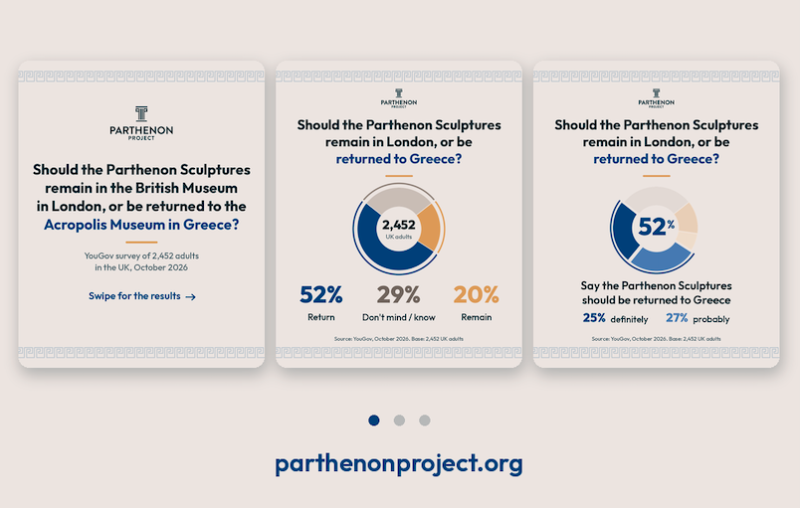
A new YouGov survey of 2,452 UK adults finds 52% in favour of return, 20% in favour of the Sculptures remaining in London, and majority support for a cultural partnership between Britain and Greece.
YouGov asked respondents a direct question on our behalf: should the Parthenon Sculptures remain in the British Museum in London, or be returned to the Acropolis Museum in Greece?
Just over half, 52%, said they should be returned to Greece. One in five, 20%, said they should remain in London. The other 29% did not mind either way or did not know.
Strength of Feeling
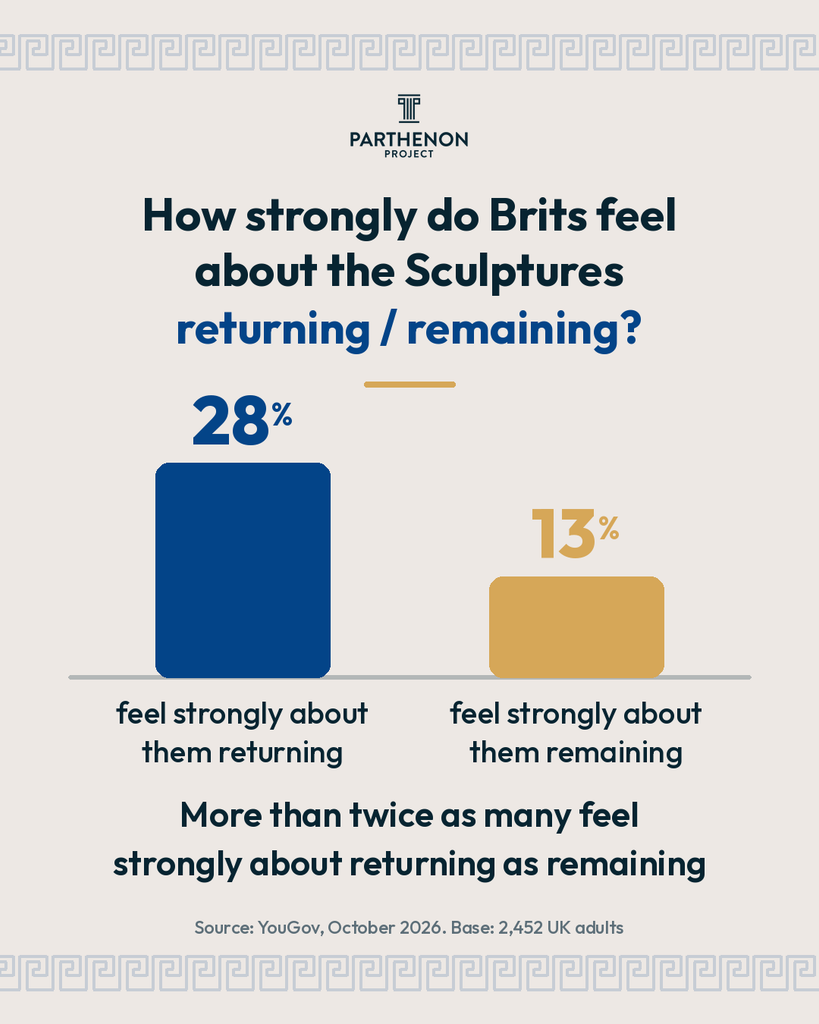
Across all UK adults, 28% feel strongly that the Sculptures should be returned, compared with 13% who feel strongly that they should remain. More than twice as many feel strongly that they should return than feel strongly that they should remain.
Displaying the Sculptures Together
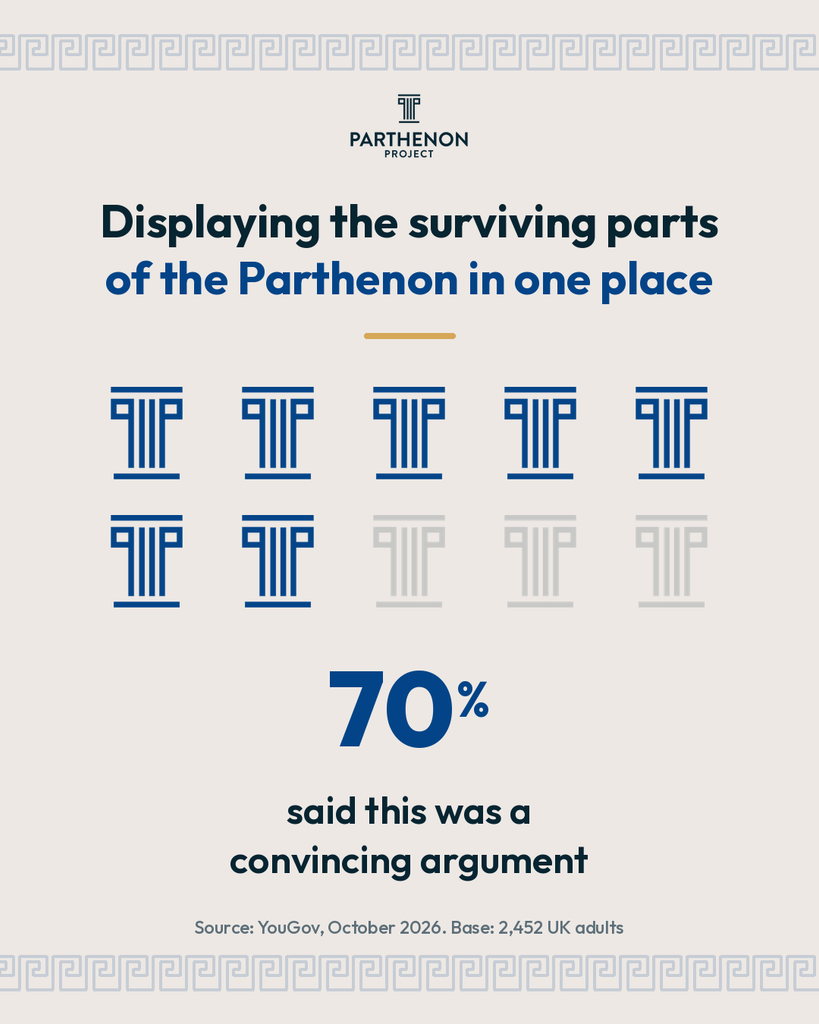
The survey also asked whether it would be better if the Sculptures were displayed together or in different museums. More than half, 54%, said it would be better to display them together, and 20% preferred different museums. Respondents were then shown five arguments, three for returning the Sculptures and two for keeping them. The argument for reunification was rated convincing by the highest proportion of respondents. The other four ranged from 33% to 65%. Seven in ten, 70%, found it convincing that reuniting the Sculptures would allow the surviving parts of the Parthenon, currently divided between London and Athens, to be displayed together in one place. A smaller group, 16%, did not find it convincing.
Support for a cultural partnership
Respondents were asked about a wider cultural partnership between Britain and Greece. Under such a partnership, the Sculptures would be returned to Athens, and museums in Britain could receive loans of major Greek artefacts and exhibitions, including objects that have not previously been displayed outside Greece.
A majority, 58%, said they would support this arrangement, and 9% said they would oppose it.
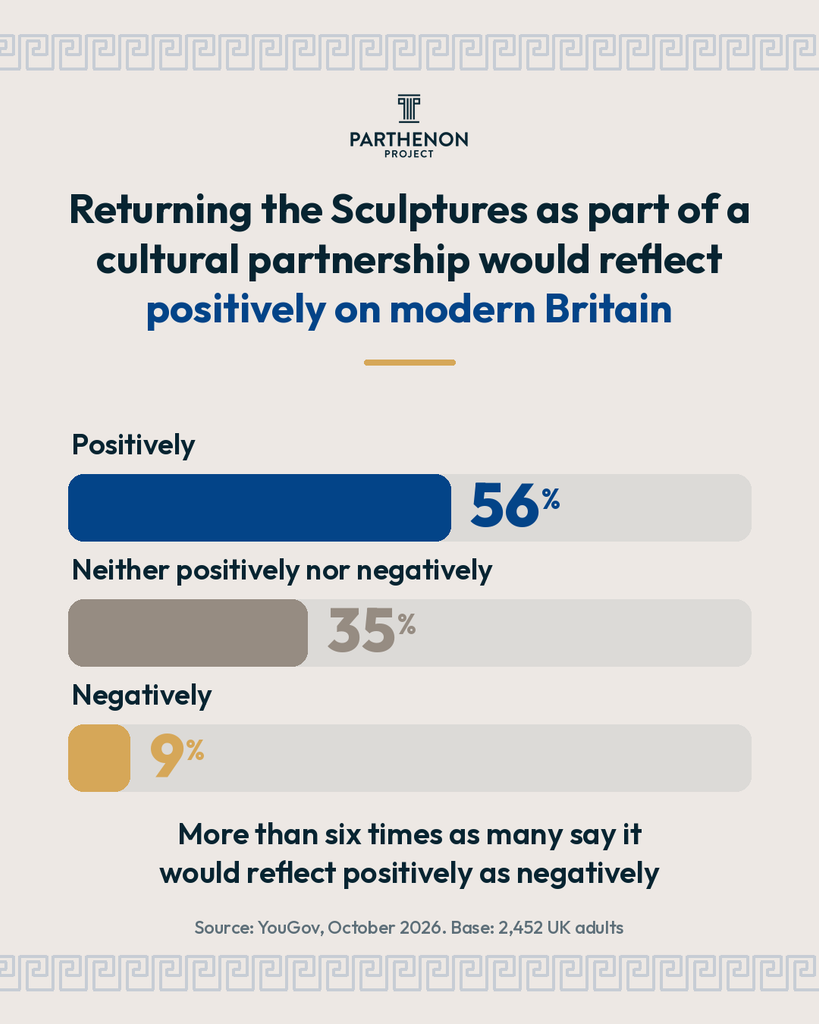
Asked how a return made as part of a cultural partnership would reflect on modern Britain, 56% said positively and 9% said negatively. The remaining 35% said neither or did not know. Separately, 70% thought a partnership of this kind would have a positive impact on the relationship between Britain and Greece.
Positive Reflection on Modern Britain
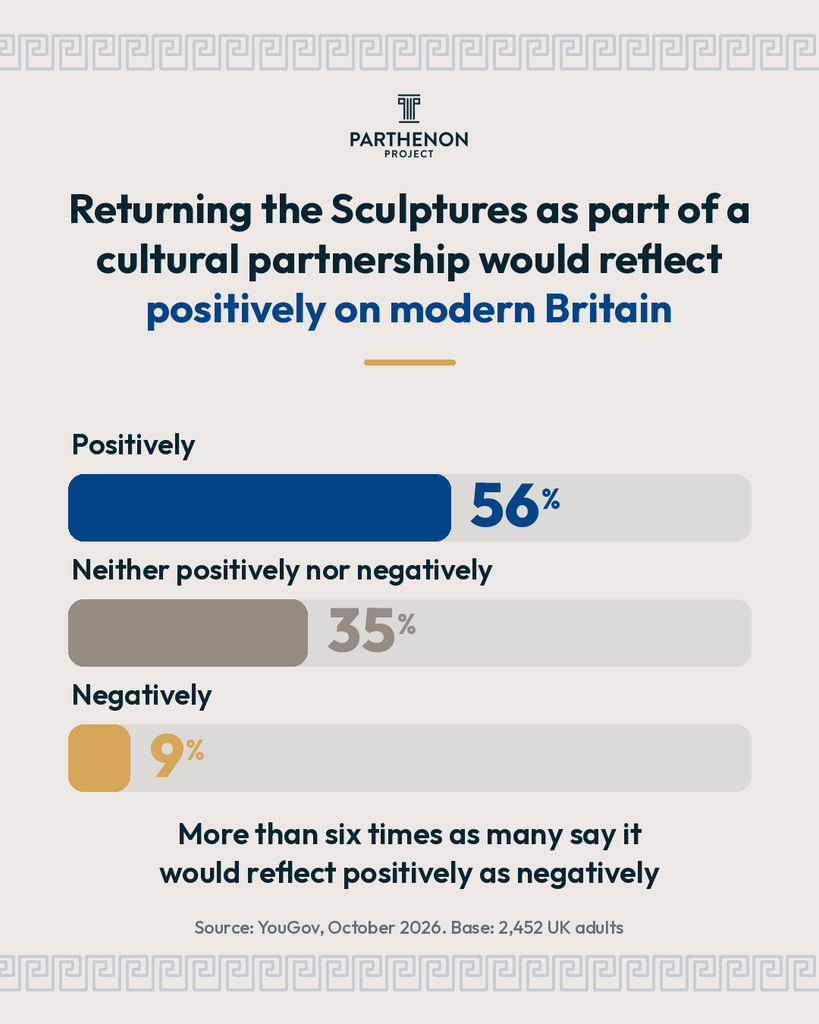
When asked if they thought returning the sculptures as part of a cultural partnership would reflect positively on modern Britain, 56% of respondents were in agreement while only 9% thought this would reflect negatively on the country.
Greek exhibitions across the UK
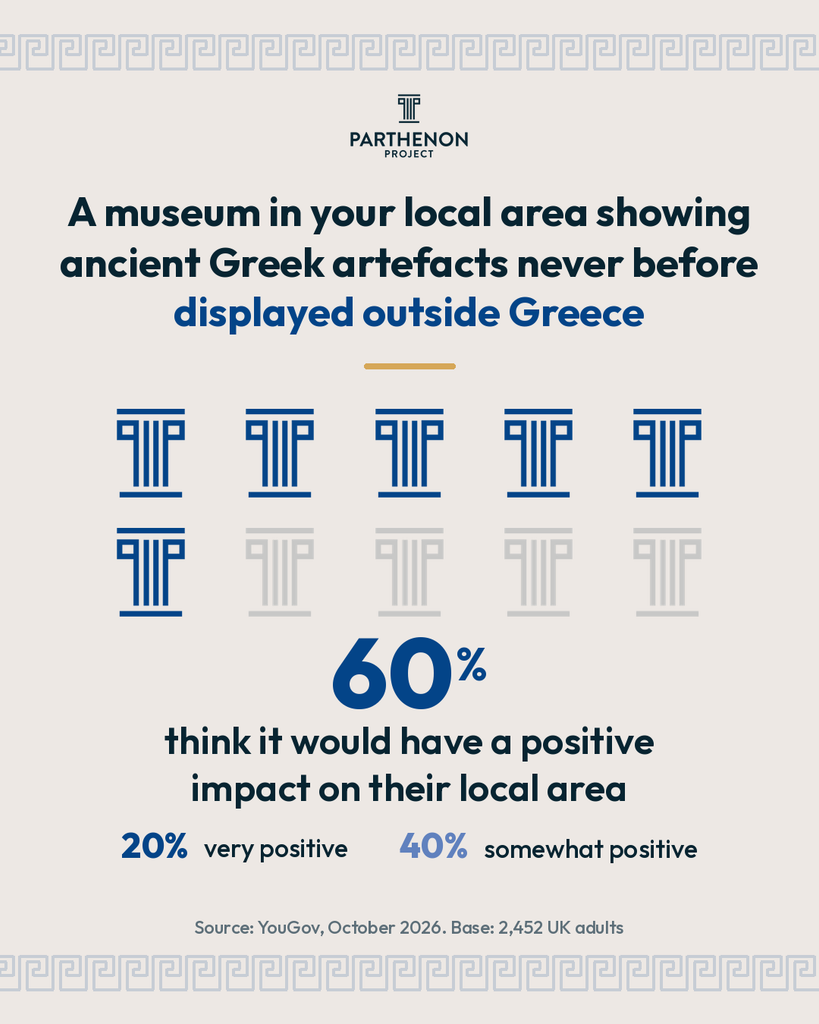
The survey also tested what a partnership could mean outside London. Support for major Greek exhibitions touring established museums around the UK was 61%, with 3% opposed.
Six in ten, 60%, think a museum in their local area displaying ancient Greek artefacts never before shown outside Greece would have a positive impact on that area. Close to half, 45%, say they would be likely to visit such an exhibition in their own region.
The Parthenon Project proposes a cultural partnership of this kind. Under its plan, the Sculptures would be reunited in Athens, and Greek treasures could go on display in museums across Britain.
Notes to editors
All figures, unless otherwise stated, are from YouGov Plc. Total sample size was 2,452 adults in UK. Fieldwork was undertaken between 11th – 12th October 2026. The survey was carried out online. The figures have been weighted and are representative of all adults in UK (aged 18+).
How Can You Get Involved?
If you would like to join the efforts to reunite the Parthenon Sculptures in Greece through a cultural partnership and receive emails with campaign updates from Pagefield Communications, please subscribe below.
For press enquiries, please contact Pagefield Communications at parthenonproject@pagefield.co.
