By David Sanderson
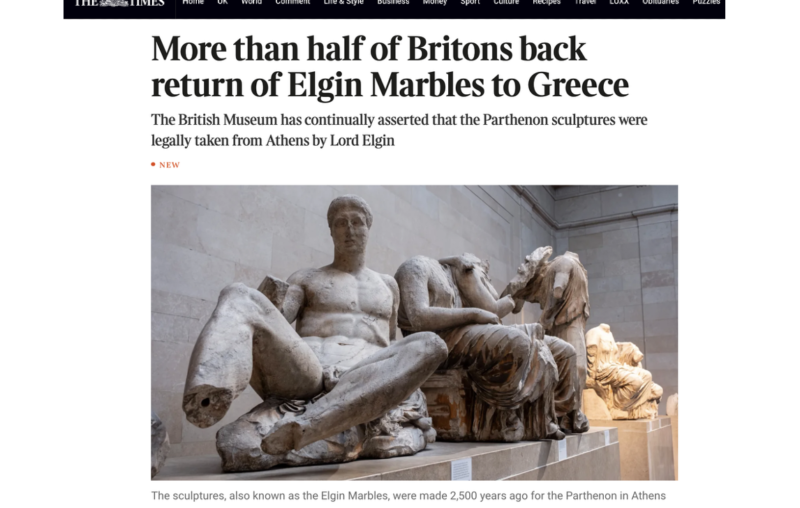
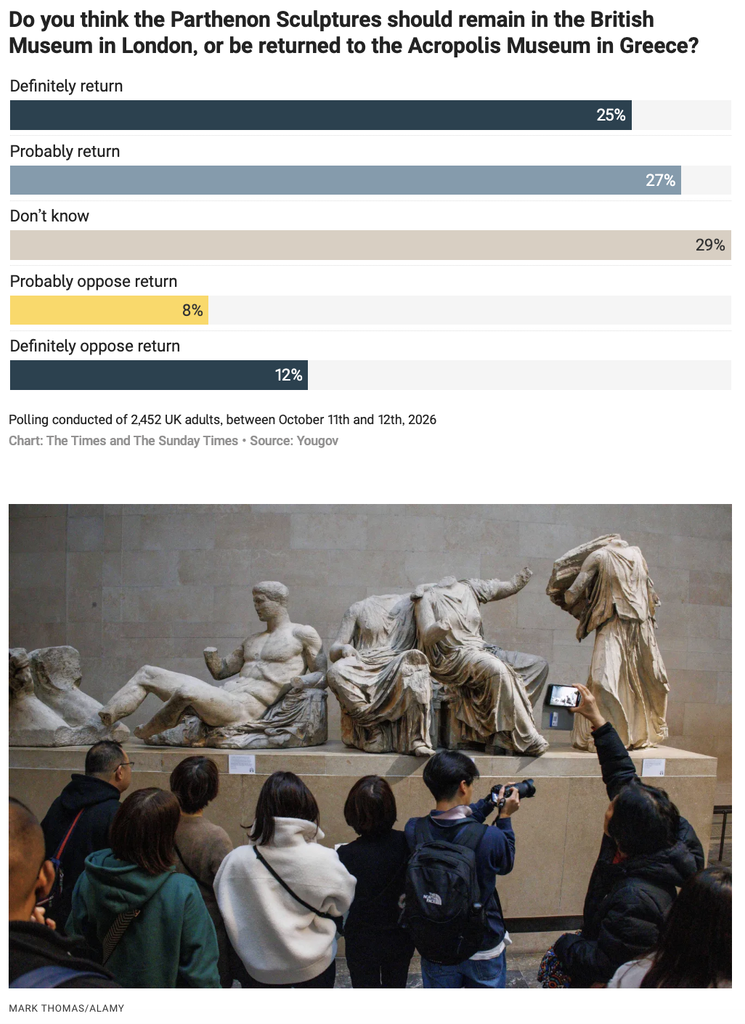
More than half of Britons think the Parthenon sculptures should be permanently returned to Athens regardless of whether Britain receives a loan of Greek treasures, according to a poll by YouGov.
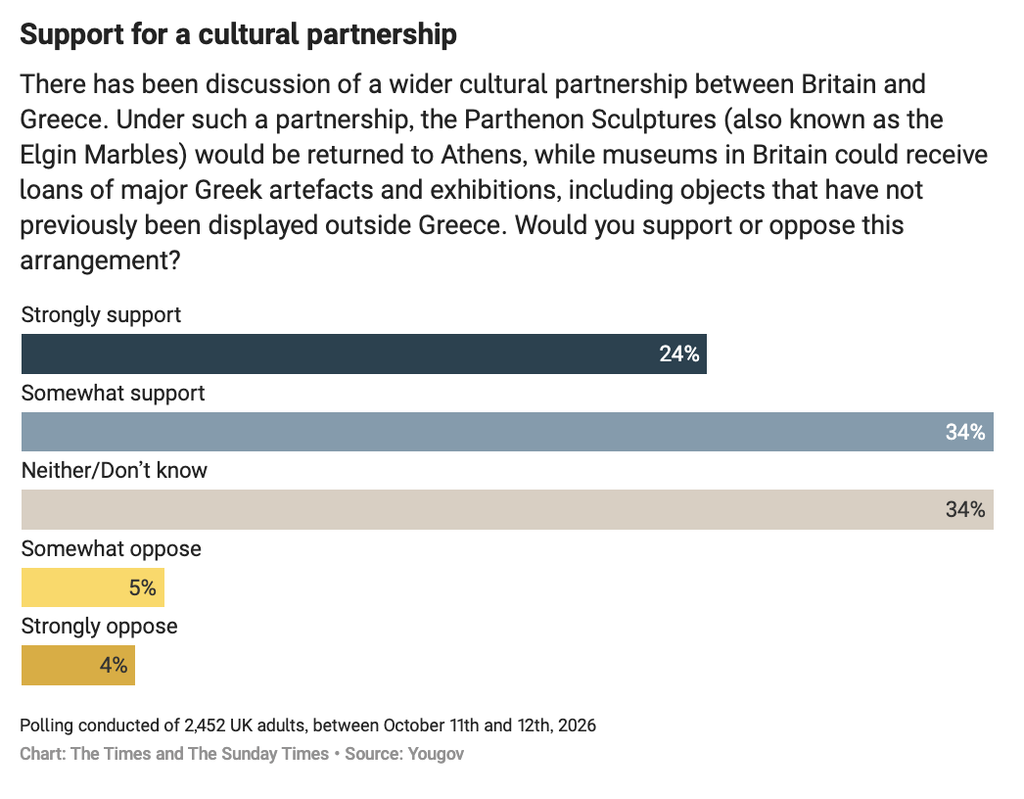
Support for the return of the Elgin Marbles to Greece from the British Museum increased when it was tied in with a reciprocal loan of artefacts, such as the Mask of Agamemnon.
Only one in five Britons now think the classical marble sculptures made 2,500 years ago to decorate the Parthenon on the Acropolis, in Athens, should remain in the British Museum.
Andy Burnham, the prime minister, has retreated from his stated view in 2023 that they should be returned to Athens with “no strings attached”. After entering No 10, he said it was a matter for the British Museum.
However, its trustees’ hands are tied by the British Museum Act 1963 that prohibits the return of artefacts beyond very limited circumstances.
Successive governments, including the current Labour administration, have ruled out amending the act despite increasing pressure from Greece and lobby groups in Britain.
George Osborne, the British Museum chairman, has been trying to agree a “loan” with Greek ministers, but this has foundered over the refusal of the Greeks to accept the museum as the ultimate owners of the sculptures.
The YouGov polling was commissioned by the Parthenon Project, which campaigns for the return of the sculptures. It found that a “cultural partnership” was backed by 72 per cent of Labour voters, compared with 60 per cent of Conservative supporters.
This is defined by the project as the “permanent” reunification of the sculptures in Athens at its Acropolis Museum, alongside a “programme of cultural exchange bringing major Greek artefacts and exhibitions” to British museums.
Supporters of reunification and members of the project welcomed the poll, which was based on a survey of about 2,500 adults in mid-October.
Sir Stephen Fry said reuniting the sculptures with Greece would be “an extraordinary act”.
Fry previously said they would be welcomed by two million people on the streets of Athens and would “be as if our Stonehenge and Big Ben and Stone of Scone all in one had been missing from our country for hundreds of years and was finally returned to where it belonged”.
“The best cultural partnerships make us see familiar things differently,” he said on Friday. “The prime minister should view this as a chance to bring remarkable Greek objects and exhibitions to audiences here — including people who may never travel to London, let alone Athens.”
Baroness Debbonaire, Labour’s former shadow culture secretary, said a cultural partnership seeing Greek artefacts coming to Britain “would help museums attract new audiences and donors”.
She added: “The public clearly understands that this debate can be resolved with wins all round.”
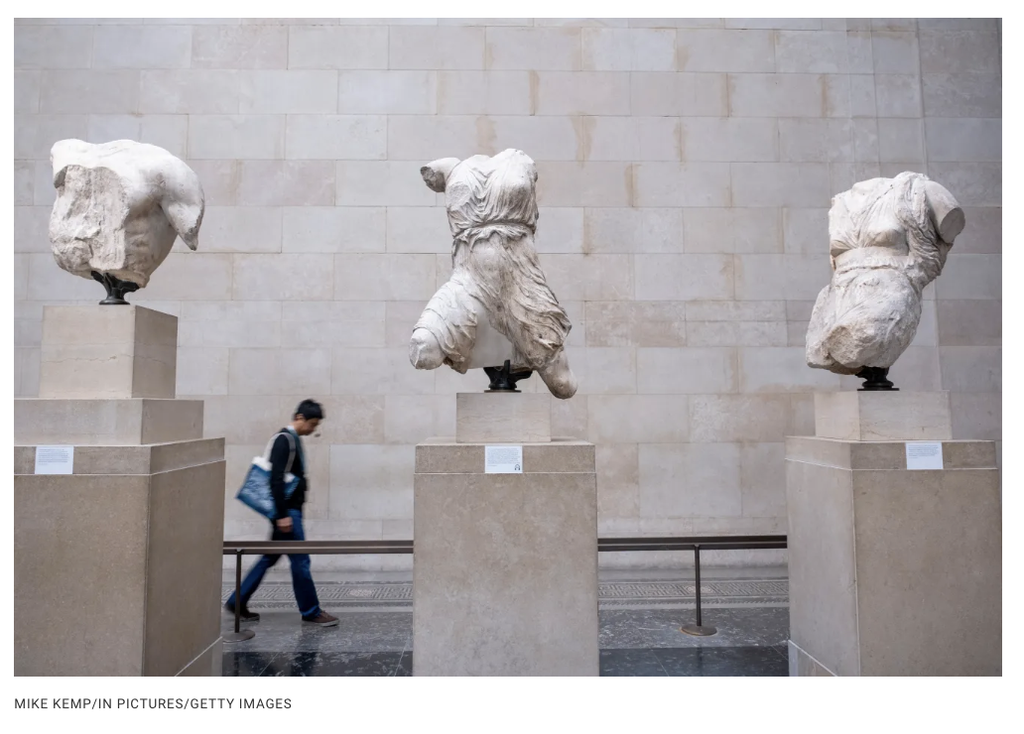
The sculptures, which account for roughly half of what remains from the Parthenon, have become the lightning rod of the restitution debate.
The museum has continually asserted that its sculptures, which were given to it by the British government in 1816, were legally taken from Athens by Lord Elgin. At the time, Greece was under Ottoman occupation.
However, there has always been opposition to Britain’s ownership of the statues, including from Lord Byron who wrote a scathing poem, The Curse of Minerva, in which he describes Elgin as a “plunderer”.
Nicholas Cullinan, the museum’s director, said in a recent interview that he hoped the loan of the Bayeux Tapestry from France would create a “precedent” for a cultural partnership with Greece. He said tangible progress would be a “wonderful” thing.
He added: “I would hope it does provide a very compelling example that international collaboration is possible, even when you don’t get there the first time or there are difficulties or tensions or things are in dispute.”
Kyriakos Mitsotakis, the Greek prime minister, who has been pushing hard for the permanent return of the sculptures, rejected the comparison.
He said: “Nobody would seriously contemplate cutting what survives of the tapestry in two and displaying half in London and half in Bayeux, and claiming this was an adequate way to understand it. Yet that is exactly what happened to the Parthenon sculptures.”
– Ends –
How Can You Get Involved?
If you would like to join the efforts to reunite the Parthenon Sculptures in Greece through a cultural partnership and receive emails with campaign updates from Pagefield Communications, please subscribe below.
For press enquiries, please contact Pagefield Communications at parthenonproject@pagefield.co.
